Ganin suffers at times from “the kind of mood that he called ‘dispersion of the will.’” The description bears an interesting resemblance to Ganin’s shadow self as film extra: “Ganin felt that the murky twilight which was gradually seeping into the room was also slowly penetrating his boedy, transforming his blood into fog, that that he was powerless to stop the spell that was being cast on him by the twilight.”
Mary, p. 9: Nabokov and Cinema
N’s career-long fascination with film and cinematic imagery begins here, in Mary, with this amazing description of Ganin working as a film extra: “Nothing was beneath his dignity; more than once he even sold his shadow, as many of us have. In other words he went out to the suburbs to work as a movie extra on a set, in a fairground barn, where light seethed with a mystical hiss from the huge facets of lamps that were aimed, like cannon, at a crowd of extras, lit to deathly brightness. They would fire a barrage of murderous brilliance, illuminating the painted wax of motionless faces, then expiring with a click—but for a long time yet there would glow, in those elaborate crystals, dying red sunsets—our human shame. The deal was clinched, and our anonymous shadows sent out all over the world.” The self as shadowy and extraneous, illuminated by artificial light, recurs throughout N’s fiction. Continue reading “Mary, p. 9: Nabokov and Cinema”
Mary, p.3: Time and the émigré
Ganin and Alfyorov, fellow Russian émigrés, are stuck in an elevator together in the novel’s opening scene. We will shortly discover that this pair thrown together by fate in the boarding house they inhabit in Berlin are further connected by the person of Alfyorov’s wife, Mary, who is soon to join him, and who turns out to be Ganin’s first love. As in many of Nabokov’s novels, nostalgia for the homeland and the plight of the exile are visible threads in the weave. The Nabokovs moved to Berlin in 1920 following their flight from Crimea in 1919 with the advance of Bolshevik troops into the region; like many a first novel, Mary has tangible autobiographical elements, and autobiographical impulses will be evident throughout N’s canon. Alfyorov relates that the house poet, Podtyagin (the same name as a character in Chekov’s story, “Oh, the Republic!”), “was arguing with me about the sense of this émigré life of ours, this perpetual waiting.” Combined with the notion of “return” often linked to the status of the exile, “perpetual waiting” can be taken to indicate waiting for the impossible return to the point of origin. Another way to put it–the paradox of waiting for the past to happen again, which afflicts many of N’s characters.
Mary, p. 1: words tripping off the tip of the tongue
First line of the novel: “‘Lev Glevo. Lev Glebovich? A name like that’s enough to twist your tongue off, dear fellow.’” First lines of Lolita: “Lolita, light of my life, fire of my loins. My sin, my soul. Lo-lee-ta: the tip of the tongue taking a trip of three steps down the palate to tap, at three, on the teeth. Lo. Lee. Ta.” One of many eerie premonitions in Nabokov’s early work revealing his fascination with naming, sound, speech, and the incarnate word on the tip of the tongue.
Mary, Nabokov’s Introduction
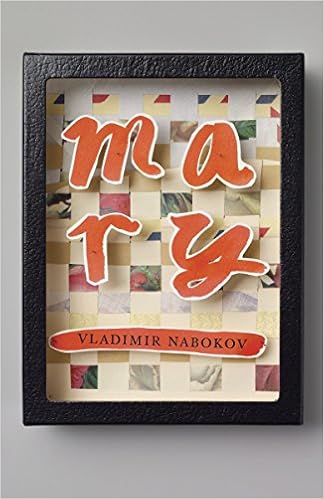
Mary (Mashen’ka), Nabokov’s first novel, published in 1926 under the pen name V. Sirin. It’s interesting that in this apprentice fiction Nabokov is already deeply invested in themes he would pursue throughout his long writing career:lost love, an attempt to re-create the past, the effects of the passage of time, the artifice of the imagination. I’m using the Vintage International edition (1970), translated from the Russian by Michael Glenny “in collaboration with the author.” Nabokov’s introduction to the English translation is typically Houdini-like: “The beginner’s well-known propensity for obtruding upon his own privacy, by introducing himself, as vicar, into his first novel, owes less to the attraction of a ready made theme than to the relief of getting rid of oneself, before going on to better things.” As I discuss the novel in detail, I’ll be referring to the page numbers in this edition.
Here’s the current Vintage International cover image: